
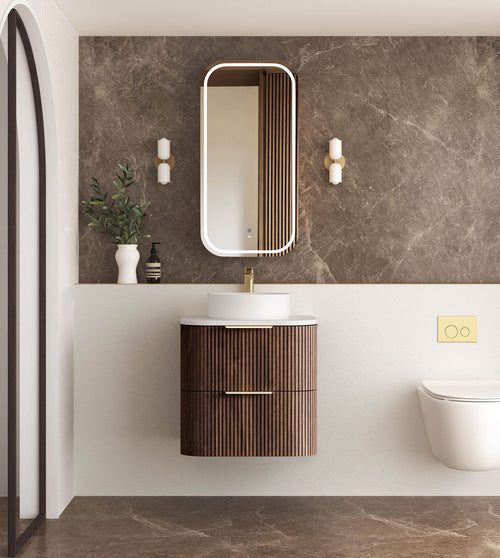
Choosing between a wall hung vanity vs freestanding vanity is one of the biggest decisions in any bathroom renovation, and it's easy to see why homeowners get stuck. One style floats above the floor for a sleek, modern finish. The other stands solidly on the ground with a timeless, furniture-like feel. At Niche Interiors Australia, we fit both styles into Gold Coast bathrooms every week, and the right answer almost always comes down to your space, your budget, and how you actually use the room — not just which style looks best in a showroom photo.
This guide breaks down the real differences between a wall hung vanity and a freestanding vanity, including cost, storage, cleaning, installation, and which one suits small bathrooms versus larger renovations.
Quick Answer: A wall hung vanity mounts directly to the wall with no floor contact, creating a floating look that suits small or modern bathrooms and makes cleaning the floor easier. A freestanding vanity sits on the floor on a plinth or legs, offering more storage, a classic aesthetic, and a simpler, cheaper installation. Neither is "better" — the right choice depends on your bathroom size, wall structure, and style.
What Is a Wall Hung Vanity?
Direct Answer: A wall hung vanity is a bathroom cabinet fixed directly to the wall with open space underneath. It's also called a floating vanity, and it's the standard choice for compact ensuites, powder rooms, and contemporary renovations across Australia.
- Mounted on concealed brackets or a batten, not the floor
- Requires a solid wall substrate (noggin, timber bearer, or reinforced plasterboard)
- Leaves the floor tile visible underneath for an open, airy feel
- Pairs naturally with fluted, curved, and matte-black hardware trends
Pro Tip
If your bathroom wall is standard plasterboard, ask your builder to install a timber bearer before tiling. Retrofitting support afterward is far more expensive than adding it during the first fix.
What Is a Freestanding Vanity?
Direct Answer: A freestanding vanity is a floor-mounted cabinet with a kickboard that fully encloses the space beneath it, similar to a piece of furniture. It doesn't rely on wall strength and is the more traditional of the two vanity styles.
- Stands on the floor on a plinth, legs, or kickboard
- No structural wall reinforcement needed
- Typically offers deeper drawers and more internal storage
- Suits Hamptons, classic, and heritage-style bathrooms
Did You Know?
Because a freestanding vanity fully covers the plumbing beneath it, it's often the easier option when a bathroom's pipework isn't perfectly straight or new.
Wall Hung Vanity Pros and Cons
Understanding wall hung vanity pros and cons in detail helps avoid a costly mismatch between your bathroom and your chosen style.
Pros
- Makes small bathrooms feel visually larger by exposing continuous floor tile
- Easier to mop and clean underneath, with fewer places for grime to collect
- Delivers a sleek, minimalist look suited to modern and Japandi-style bathrooms
- Adjustable mounting height, useful for accessibility or tall households
Cons
- Needs a structurally reinforced wall, adding to labour and preparation cost
- Generally offers less internal storage than an equivalent freestanding unit
- Exposed plumbing beneath the cabinet can look untidy if not finished well
- Weight limits apply, so oversized stone benchtops need extra bracing
Freestanding Vanity Pros and Cons
Pros
- Straightforward installation that works with almost any wall type
- More storage volume, ideal for families or shared bathrooms
- Fully hides plumbing and waste pipes behind the kickboard
- Classic look that ages well and suits resale value in established homes
Cons
- Takes up visible floor space, which can make small bathrooms feel tighter
- Can trap moisture and debris underneath if not sealed correctly
- Removing or repositioning it later may leave marks on existing floor tiles
- Less adjustable once installed, since the base is fixed to the floor
Side-by-Side Comparison
|
Feature |
Wall Hung Vanity |
Freestanding Vanity |
Best Choice |
|
Small bathroom (under 4m²) |
Excellent — opens up floor space |
Can feel cramped |
Wall hung |
|
Storage capacity |
Moderate |
High |
Freestanding |
|
Installation cost |
Higher (wall reinforcement) |
Lower |
Freestanding |
|
Cleaning the floor |
Fast, no obstruction |
Requires cleaning around base |
Wall hung |
|
Classic / Hamptons style |
Less suited |
Ideal |
Freestanding |
|
Modern / minimalist style |
Ideal |
Achievable with slim legs |
Wall hung |
|
Plumbing flexibility |
Needs tidy pipe finishing |
Fully concealed |
Freestanding |
|
Resale appeal |
Popular in contemporary homes |
Timeless style with broad buyer appeal |
Freestanding |
Pros, cons, and best use cases: a wall hung vanity wins on space and modern styling, making it the go-to for ensuites, powder rooms, and contemporary main bathrooms. A freestanding vanity wins on storage and installation simplicity, making it the practical pick for family bathrooms, period homes, and budget-conscious renovations.
Why Most Vanity Guides Get This Wrong
Most bathroom vanity buying guide Australia articles treat this as a purely aesthetic decision. It isn't. Three myths keep tripping renovators up:
Myth 1: "Wall hung is always more expensive." True for supply and install, but a wall hung vanity vs freestanding vanity comparison should also weigh long-term cleaning time and floor tile wear, where wall hung often comes out ahead.
Myth 2: "Freestanding vanities are outdated." Freestanding designs have evolved considerably, with fluted timber finishes and slimline legs now common in contemporary Australian ranges, not just Hamptons-style homes.
Myth 3: "Any wall can hold a wall hung vanity." This is the mistake that causes the most callbacks. Standard plasterboard without a bearer will not safely support a stone-top wall hung vanity long-term, regardless of the bracket used.
Cost Comparison: Wall Hung vs Freestanding Vanity
Quick Answer: Freestanding vanities are typically $100–$500 cheaper to install than wall hung vanities of the same size, because wall hung units need reinforced wall backing and more precise plumbing work.
- Entry-level freestanding vanity (600–900mm): roughly $400–$1,500 supplied
- Entry-level wall hung vanity (600–900mm): roughly $600–$1,500 supplied, plus wall reinforcement
- Mid-range vanity with stone benchtop (either style): roughly $1,500–$3,000 installed
- Premium or custom vanity (1200mm+): $3,000–$8,000+, depending on benchtop and cabinetry
What Drives the Final Price
- Cabinet size and material (laminate, timber veneer, or engineered wood)
- Benchtop choice (laminate versus engineered or natural stone)
- Wall preparation, if wall hung and the substrate isn't already reinforced
- Plumbing adjustments, especially if the basin position is moving
- Hardware quality, such as soft-close drawer runners and tapware
Which One Suits Your Bathroom? Industry Perspective
After years of fitting both styles across Gold Coast renovations, a pattern is clear: the decision rarely comes down to trend alone. It comes down to three practical questions.
How much storage do you actually need? A single-person ensuite rarely needs the drawer depth a family bathroom does. If you're storing hairdryers, cleaning products, and spare towels, a freestanding vanity's extra volume tends to win.
What's your wall built from? In older Queensland homes with solid brick or block walls, a wall hung vanity is usually straightforward. In newer builds with standard plasterboard, ask early — reinforcement is far cheaper before tiling than after.
Are you renovating to sell or to stay? Buyers responding to current listings tend to favour the streamlined look of a wall hung vanity in ensuites, while a freestanding vanity still reads as a safe, broadly appealing choice in a main family bathroom.
Quick Win
If you're undecided, measure your bathroom footprint first. Under roughly 4 square metres, a wall hung vanity vs freestanding vanity decision usually tips toward wall hung purely on the visual space it frees up.
Choosing a Vanity for Gold Coast Bathrooms
Coastal humidity across the Gold Coast, from Southport to Burleigh and the Broadwater suburbs around Bundall, puts extra demand on cabinetry. Moisture-resistant carcass materials and quality edge sealing matter more here than in drier inland climates, whichever style you choose.
- Ventilation matters as much as vanity style in humid coastal bathrooms
- Timber-look finishes need proper sealing to resist swelling near showers
- Wall hung vanities suit the compact ensuites common in Gold Coast unit renovations
- Freestanding vanities remain popular in larger family homes across the region
Common Mistakes to Avoid
- Choosing a style based only on a photo, without measuring the bathroom first
- Skipping wall reinforcement checks before ordering a stone-top wall hung vanity
- Underestimating storage needs in a shared family bathroom
- Forgetting to check waste and supply pipe height before finalising vanity position
- Assuming installation cost is identical regardless of style
FAQs
Q: Is a wall hung vanity or freestanding vanity better for a small bathroom?
A wall hung vanity is usually better for small bathrooms because it exposes continuous floor tile, which visually opens up the space and makes the room feel larger.
Q: Which is cheaper: wall hung or freestanding vanity?
A freestanding vanity is typically cheaper to install because it doesn't require wall reinforcement, saving $100–$500 in most standard installations.
Q: Can I install a wall hung vanity on any wall?
No. A wall hung vanity needs a solid substrate such as a timber bearer, noggin, or reinforced plasterboard. Standard plasterboard alone cannot safely support a heavy stone-top unit.
Q: Do wall hung vanities hold as much storage as freestanding vanities?
Generally no. Freestanding vanities offer deeper drawers and more internal volume, making them a stronger choice for family bathrooms with heavier storage needs.
Q: Are wall hung vanities suitable for older Gold Coast homes?
Yes, provided the wall is checked for structural strength first. Many older Gold Coast homes have solid brick or block walls that suit wall hung installation well, though newer plasterboard walls may need reinforcement.
Q: Which vanity style holds up better in humid coastal bathrooms?
Both styles perform well with the right materials. Moisture-resistant cabinetry and proper sealing matter more than the mounting style in humid Gold Coast bathrooms.
Q: Do freestanding vanities go out of style?
Not in Australia's current market. Fluted timber finishes and slim-leg designs have kept freestanding vanities relevant in contemporary renovations, not just classic or Hamptons-style homes.
Final Word
There's no universal winner in the wall hung vanity vs freestanding vanity debate — only the right fit for your bathroom, your household, and your budget. If space and a modern finish matter most, a wall hung vanity is usually worth the extra installation step. If storage and a classic, low-fuss install matter more, a freestanding vanity remains a smart, dependable choice. Whichever direction you lean, Niche Interiors Australia can help you compare both styles in person, check your wall structure, and find a vanity that fits your bathroom and budget.
Ready to compare vanities in person? Visit the Niche Interiors Australia showroom in Bundall or book a consultation to find the right wall hung or freestanding vanity for your renovation.
